
Italian winemakers unite in the battle to save historic Collio vineyard
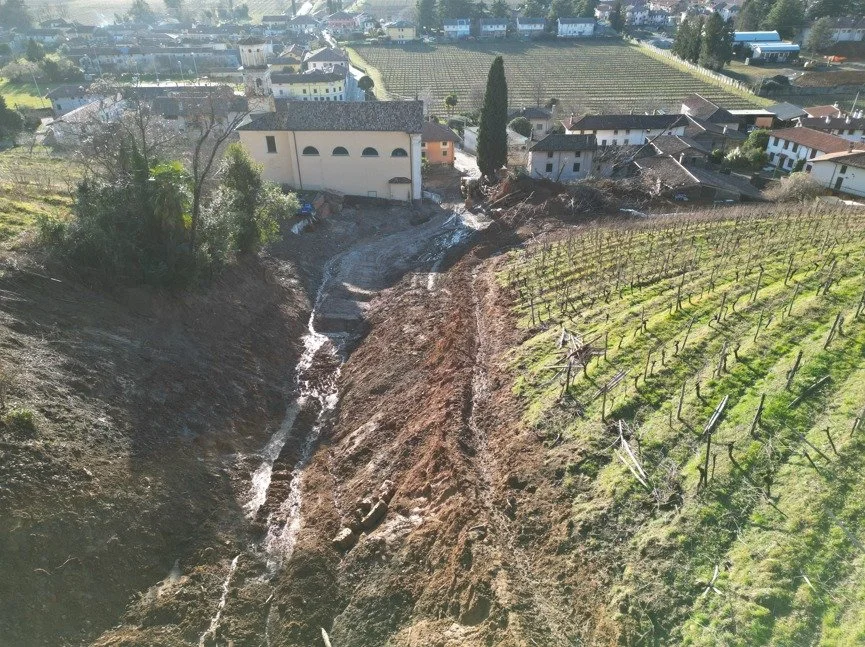
The aftermath of a landslide in November 2025, which swept away a quarter of the 80 year-old Ronco della Chiesa vineyard and left the Borgio del Tiglio winery unable to operate
An environmental disaster has highlighted the need for a paradigm shift in protecting fragile old vine landscapes.
In the global effort to document and preserve old vines, we frequently celebrate them as resilient living monuments—repositories of unique genetic diversity, profound cultural history, and irreplaceable terroir expression. Yet, these historic sites are also at risk from extreme weather caused by climate change, as well as modern interventions that can disrupt the delicate ecological balance of agricultural systems developed over centuries.
This fragility became starkly apparent following a severe environmental disaster in northeastern Italy, which has sparked an unprecedented national movement among the country’s independent winemakers.
On November 17, 2025, torrential rains triggered major landslides on the slopes of Mount Quarin in Brazzano, located in the heart of the renowned Collio region of Friuli-Venezia Giulia. The disaster directly struck the historic Ronco della Chiesa vineyard, causing devastating damage to its soils and vines.
To understand the true scale of the crisis and what it means for Italian viticultural heritage, The Old Vine Conference spoke with Mattia Manferrari, son of Nicola Manferrari, founder of the Borgo del Tiglio estate, custodians of this historic vineyard planted in the 1950s.
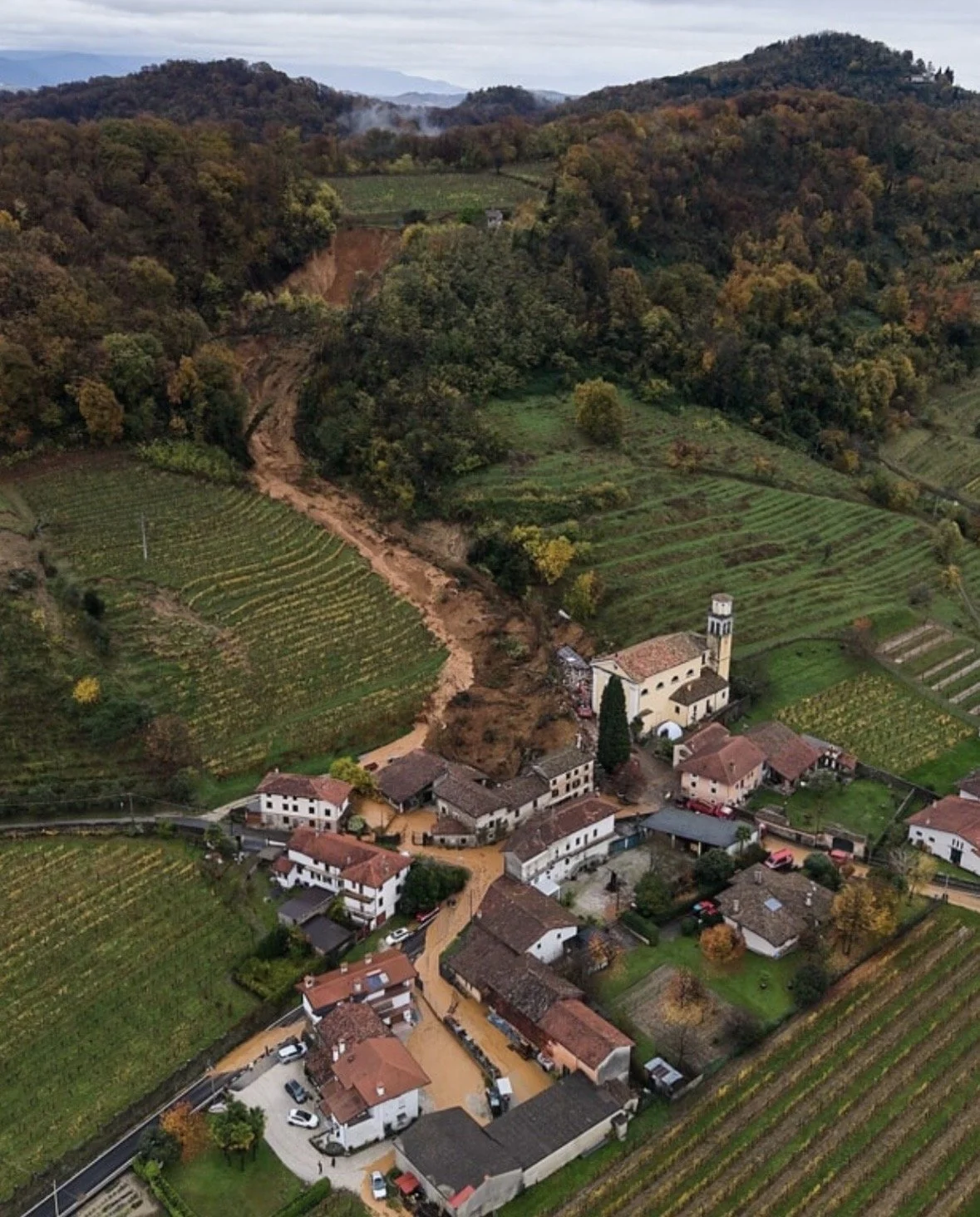
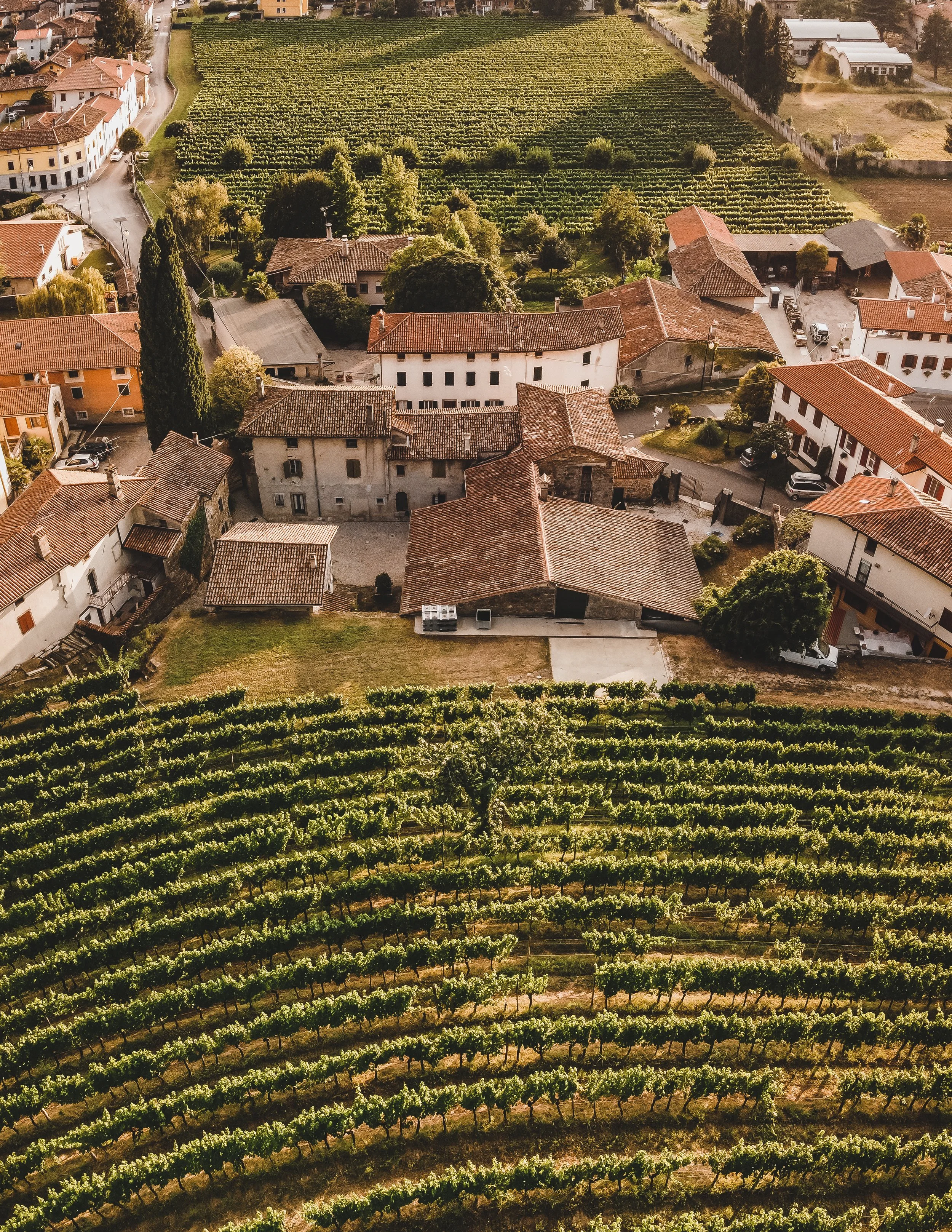
An aerial image showing the mud and water that washed away part of the Collio estate’s historic vines
Double the Damage
In November 2025, the Ronco della Chiesa vineyard sustained extensive damage after two land movements swept away part of both the left and right flanks, affecting 25% of the vineyard surface, as Mattia explains:
Landslide A (The Right Flank): "Looking from downstream, the vineyard was hit by a huge landslide on its right flank, coming from the woods above," Mattia notes. This slide tore through a fascia of about 10 to 20 vines per row. Crucially, the detachment did not happen naturally; it originated from a meadow belonging to a holiday house further up the mountain, an area that had been artificially flattened in a zone originally anchored by natural woodland.
Landslide B (The Left Flank): Following a 2017 landslide on a neighbouring vineyard that was never properly remediated by the authorities, a massive chunk of land shifted. It completely obstructed a small, historic water channel designed to route rainwater safely downstream. "This caused a huge amount of water to be conveyed directly onto the Ronco della Chiesa vineyard," Mattia explains. "It caused a much smaller but, for the vineyard itself, more severe damage, resulting in the immediate loss of about 500 plants."
"The plants are almost 80 years old, so it is absolutely devastating," Mattia says. "But the deepest damage risks being the permanent loss or alteration of the original soil. While the vineyard we see today was planted in the 1950s, we know from local accounts that a vineyard stood here in the 1930s with minimal intervention to the terraces, so this is a very old example of Friulian viticulture."
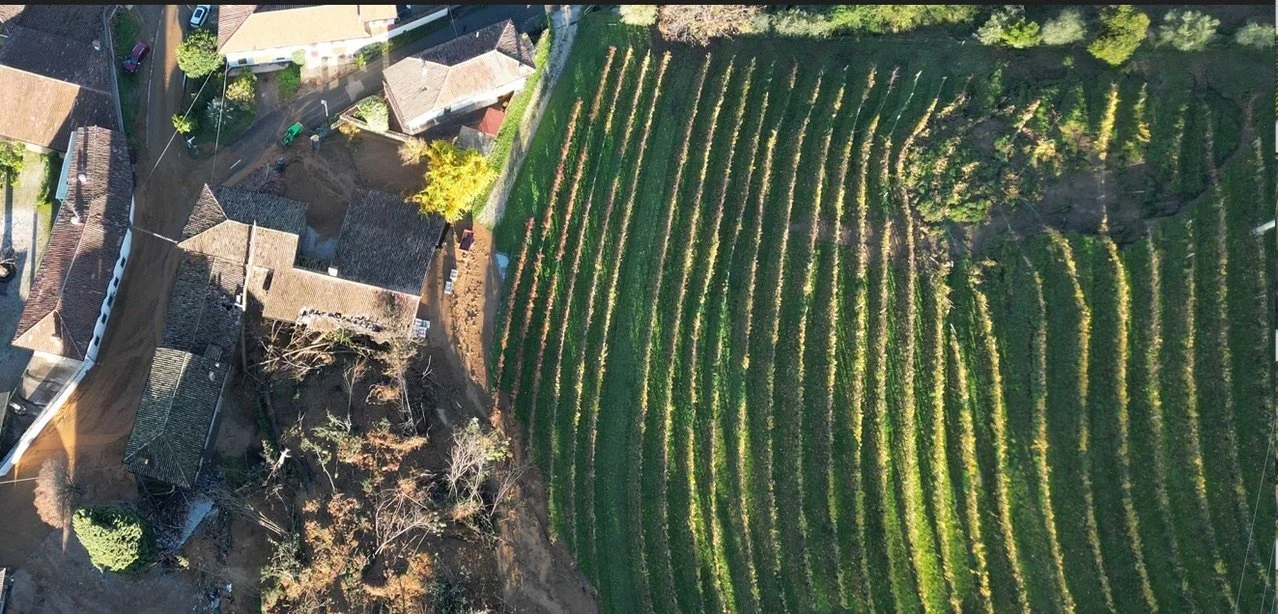
An overhead image showing the damage sustained to the vines by land movements
Traditional Knowledge as Ecological Defence
The old vines of Ronco della Chiesa also represent the delicate, historic balance between human agriculture and natural ecology.
"Ronco della Chiesa harks back to an age where farmers and vine growers had a deeper connection with their land," says Mattia. "They knew, through a rich and sophisticated but mostly oral culture, how to manage the terrain in a deeply respectful way. This wasn’t an ideology; it was a matter of pure necessity. No one wanted their land to be part of a landslide, and they didn’t have excavators or caterpillars. Infinite attention was placed on finding the best possible balance between cultivation and hydrogeological stability."
Mattia points out that the vulnerability of the modern Collio landscape is rooted in the industrial boom of the 1960s and 1970s. When heavy machinery arrived in Friuli, thousands of farmers left the land for factories, fracturing the chain of shared ancestral knowledge:
"These machines offered an apparently cheap, fast solution. Terraces were made significantly bigger to make room for large tractors. Land that had previously been left to the woods began to be cleared, and massive, artificial, flat chunks of land were introduced where steep natural slopes once stood. It is not a coincidence that almost all landslide movements in this area today originate from those 1960s and 70s terracing and earthmoving works."
In contrast, the historic Ronco della Chiesa parcel features narrow terraces and a perfectly integrated water-drainage system. The soil has not been fertilised or tilled since the 1980s. The vineyard essentially functions as a self-sustaining ecosystem, yielding Borgo del Tiglio's highest-quality Tocai (Friulano) grapes.
As further proof of the value of traditional hydro-ecological management, Mattio points out that the historic vineyard enclosed by an ancient crenellated wall was untouched by the landslips
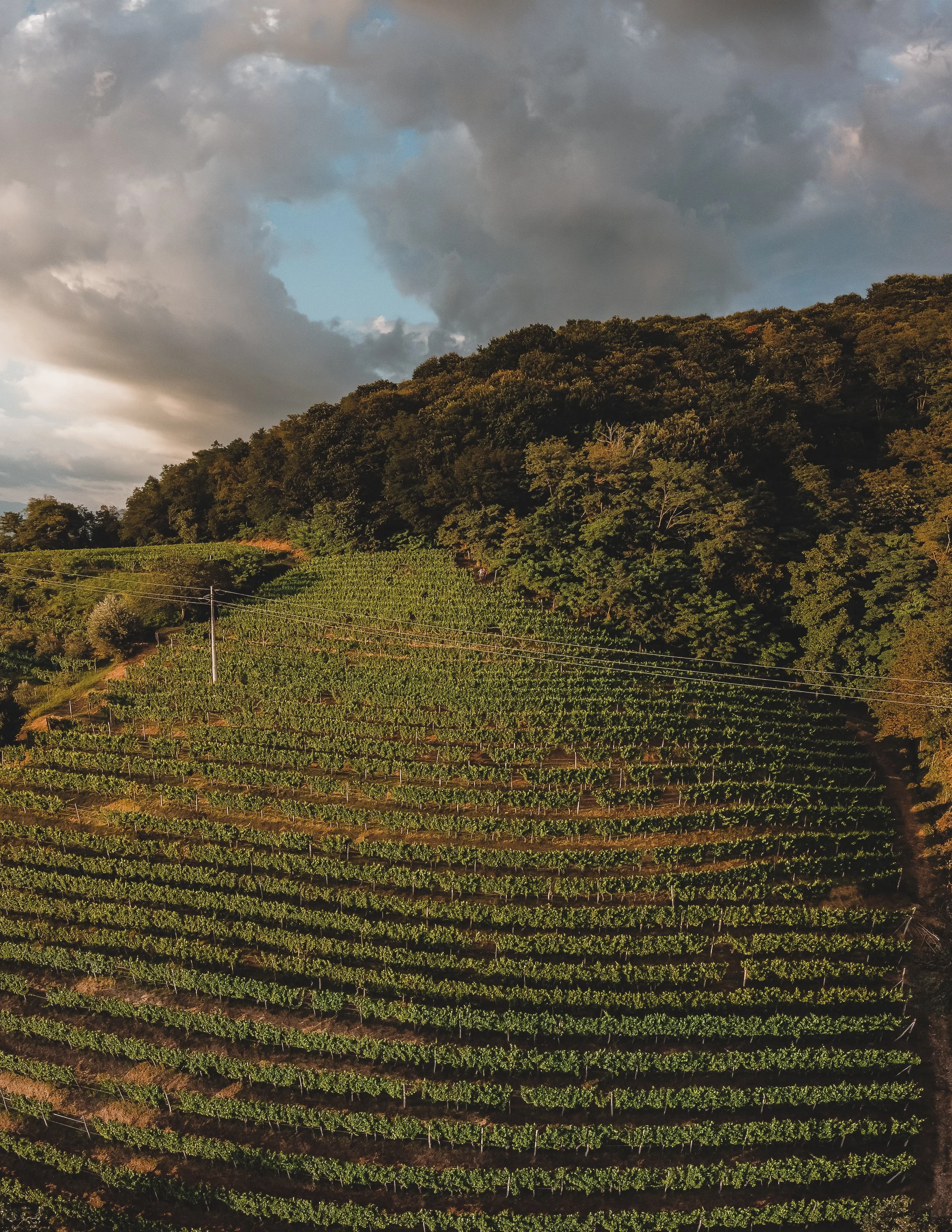
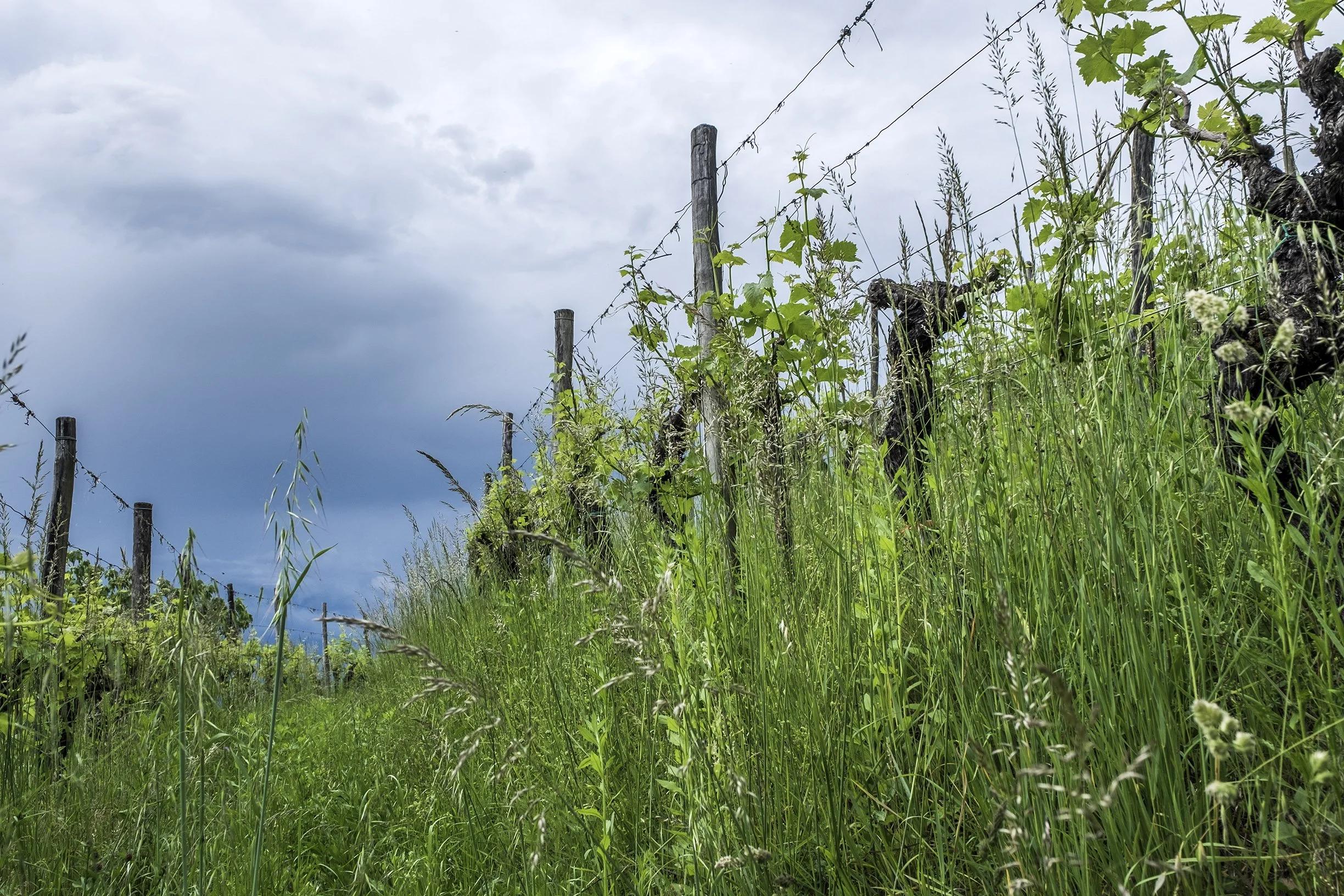
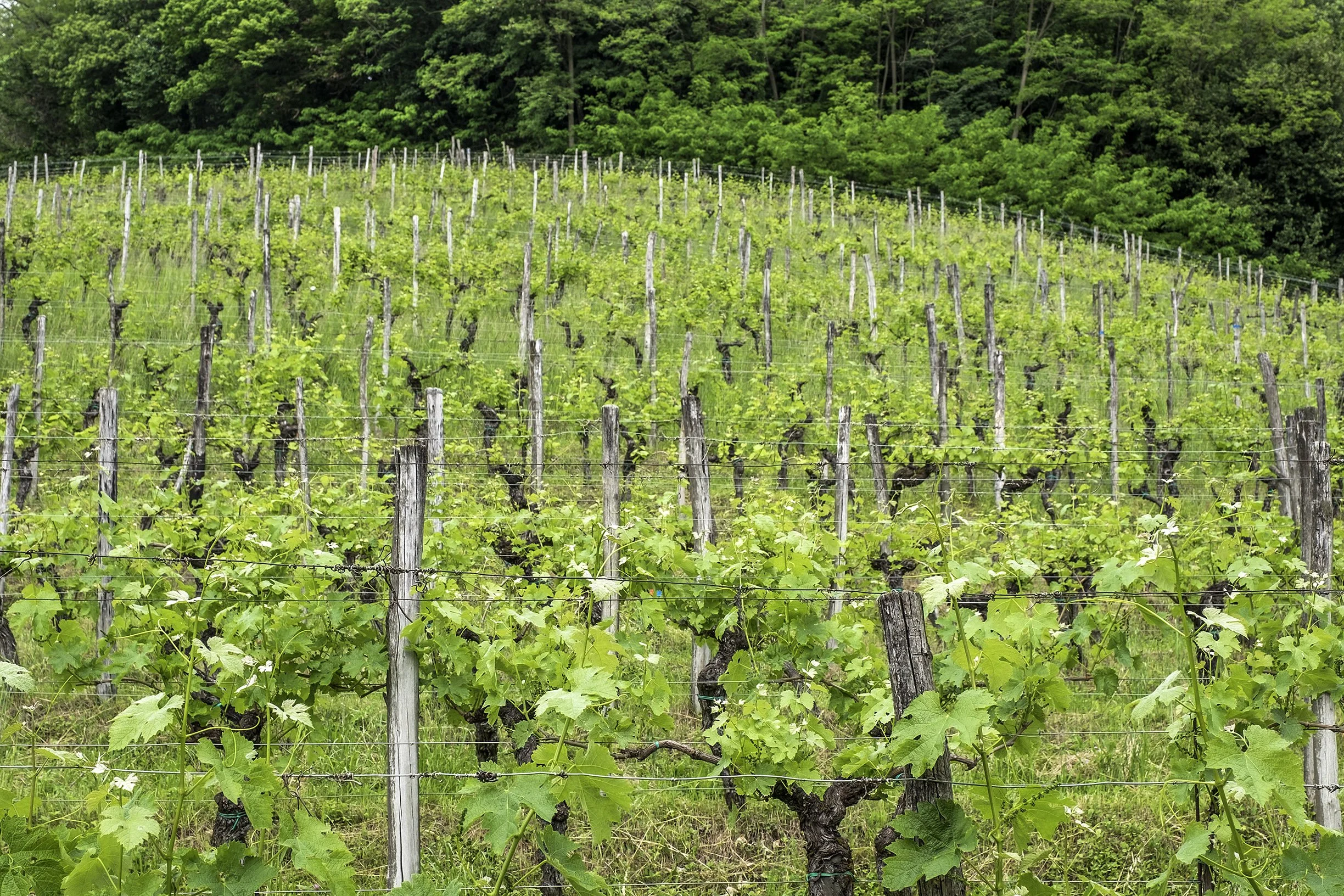
Images showing the traditional trellising techniques and cover crops grown to protect the integrity of the soil
The Threat of "Top-Down" Engineering
It is this delicate agronomic harmony that independent winemakers fear will be permanently destroyed by the state's impending emergency response. The coalition Vignaioli per il Ronco della Chiesa, mobilised rapidly at the Vinitaly wine exhibition under the guidance of natural wine pioneer Walter Massa, has petitioned regional President Massimiliano Fedriga for a collaborative approach.
The threat, Mattia warns, is that public authorities are still operating with an outdated engineering mindset.
"To fix Landslide B, the authorities want to use massive steel structures anchored deep into the rock beneath," Mattia reveals. "We consulted several independent geological experts, including Yves Herody, one of the world's leading authorities on geology applied to vineyard environments. They expressed profound concern. Fracturing this specific bedrock—which is a fragile, layered type of sandstone known as flysch—could introduce severe further instability into the system and cause an even larger portion of the hillside to collapse. Beyond that, heavy engineering will completely alter the soil profile, the water management, and the exact agronomic characteristics that make this vineyard's terroir unique. We are simply asking to restore the slope using traditional methods—the very ones that kept these hills stable for decades."
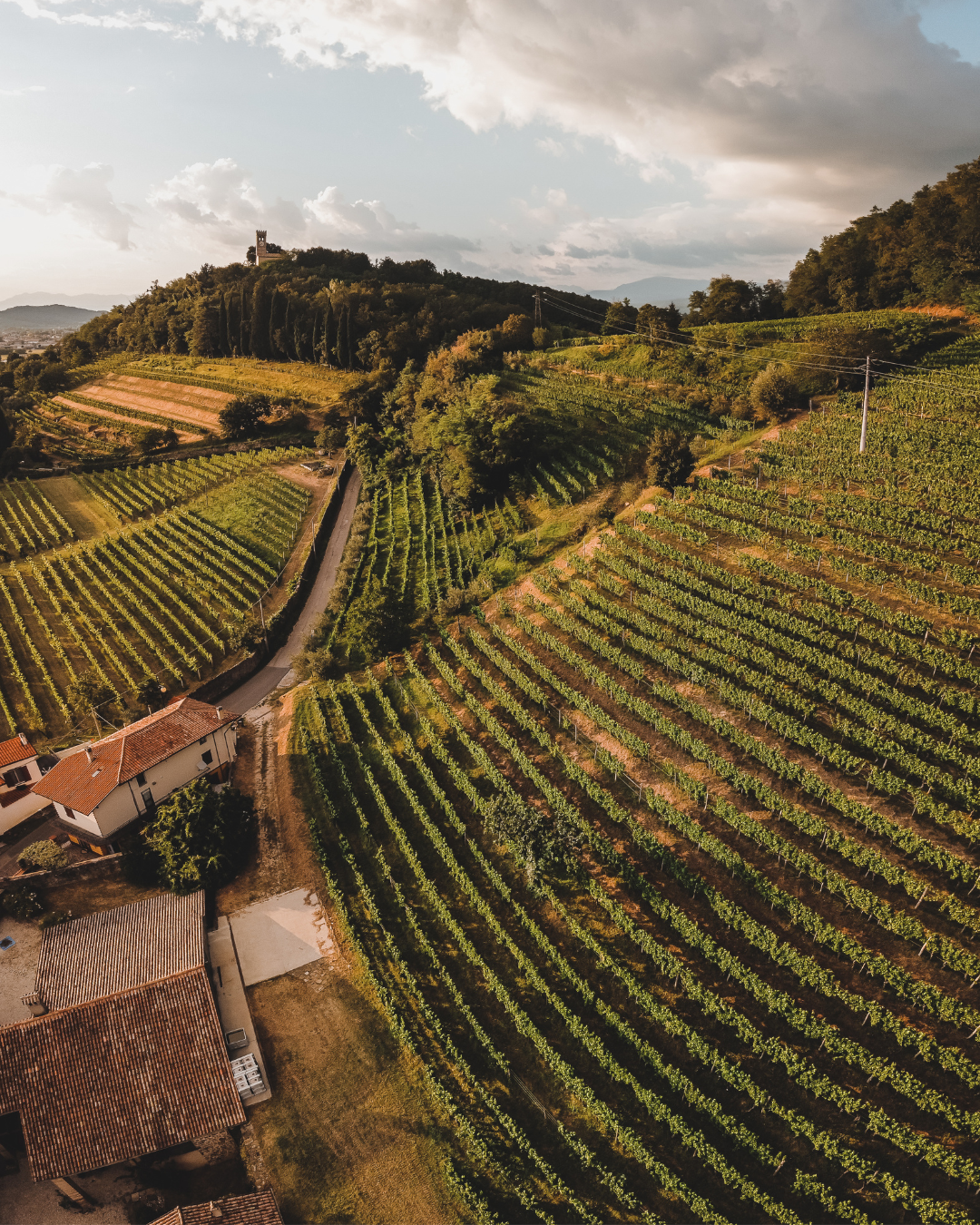
The historic Ronco della Chiesa parcel features narrow terraces and a perfectly integrated water-drainage system.
A Flagship Estate in Crisis
The fallout of the November 2025 landslide is not just an environmental issue; it has become an immediate existential threat to Borgo del Tiglio’s operations. The estate’s flagship wines, including Ronco della Chiesa and the acclaimed Merlot Rosso della Centa, both rely heavily on the fruit harvested from this historic slope.
Worse still is the bureaucratic gridlock that means that production has ground to a halt.
"In the short term, our biggest problem is that our wine cellar is still officially classified by the government as a 'red zone' (zona rossa)," Mattia shares. "Access is entirely prohibited; we are legally barred from doing any work inside our own facility. This means the upcoming 2026 harvest is in imminent danger. Moving our entire production operation somewhere else would incur an astronomical cost. Even if the red zone restriction is lifted tomorrow, massive structural reparations are required before we can safely resume work."
This operational shutdown has cut off the estate's ability to self-finance its recovery at the exact moment cash is needed most. According to Mattia, public relief funds remain completely inadequate, and massive, invasive infrastructure projects are currently being drawn up for their small hamlet without local consultation. "It was incredibly difficult for us to even gain access to the blueprints, let alone discuss them with the planners," he says.
The Vignaioli per il Ronco della Chiesa movement
The rapid formation of Vignaioli per il Ronco della Chiesa at Vinitaly saw high-profile winemakers from every corner of Italy—from the alpine heights of Alto Adige down to the volcanic slopes of Sicily—signing their names to the manifesto. The movement has resonated deeply across the peninsula because Italian winemakers recognise that their country's diverse, mountainous geography is universally fragile. Landslides and flash floods are an omnipresent threat; what struck Borgo del Tiglio today could strike a historic plot in Etna, Barolo, or Chianti tomorrow.
"I must send an immense thank you to Walter Massa," Mattia says. "He stepped in immediately to help forge this network of winemakers who share a common belief. We need to build a completely new legal framework and a modern executive approach from our authorities when responding to emergencies like this."
The conflict over Ronco della Chiesa highlights a global challenge facing old-vine advocates worldwide. Farmers and independent vine growers are the primary wardens of our most beautiful, historic landscapes. Without open, constructive cooperation between institutional authorities and the people who look after the soil, these irreplaceable cultural treasures will vanish.