
Carla Benini: Preserving Viticultural Heritage, from Nocchianello Nero to the Italian Academy of Vine and Wine
By Michele Shah, OVC Regional Ambassador for Italy
At member Sassotondo, in Pitigliano, the recovery of an almost forgotten grape variety illustrates why preserving Italy’s viticultural heritage matters for the future of wine.

Carla Benini, owner of Sassotondo has been appointed to the prestigious Italian Academy of Vine and Wine
The appointment of Carla Benini, owner of Sassotondo and a longstanding guardian of Nocchianello Nero, to the prestigious Italian Academy of Vine and Wine provides an opportunity to reflect on a subject central to the old-vine movement: the importance of preserving the genetic diversity accumulated in our vineyards over generations.
Her work also connects with the objectives of G.R.A.S.P.O., the organisation dedicated to researching, identifying and safeguarding rare and endangered grape varieties. The recovery of Nocchianello Nero illustrates what is at stake when old vineyards disappear and the plant material they have preserved is lost with them.
A recognition of scientific and professional commitment
Founded in 1949 by the Ministry of Agriculture, the Italian Academy of Vine and Wine is a cultural and scientific institution dedicated to the study and promotion of Italian viticulture and oenology. Through scientific research, it seeks to safeguard the quality and international reputation of Italian wine.
Today, the Academy has approximately 600 members, including university professors, researchers, oenologists, agronomists, wine producers and specialist journalists. It is led by Professor Rosario Di Lorenzo.
Membership represents significant recognition of a professional contribution to the development, understanding and protection of the vine and wine. In Carla Benini’s case, that contribution extends well beyond running a winery. It encompasses scientific research, sustainable viticulture and the conservation of grape varieties that might otherwise have disappeared.
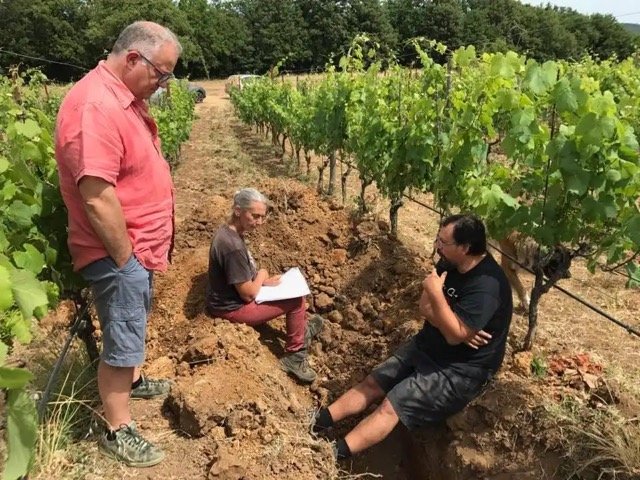
Carla Benini in the vineyard with agronomist Attilio Pagli (left, in pink shirt)
Sassotondo: A vineyard shaped by its territory
To understand Carla’s work, it is worth looking at the place where it has developed.
Sassotondo lies in the area of Pitigliano and Sorano, in southern Tuscany, a landscape shaped by Etruscan civilisation, ancient roads carved into the rock known as vie cave, volcanic tufa formations and cellars excavated directly into the stone.
The estate covers 72 hectares, of which 13 are planted with vines. The land has always been managed according to organic farming principles, and the wines reflect the distinctive character of this sometimes demanding territory.
Carla graduated in Agricultural Sciences from the State University of Milan before completing a Master’s degree in Agricultural and Food Economics in Cremona. She initially worked as a consultant in the agri-industrial sector, concentrating particularly on issues relating to subsidised public financing.
In 1990, she decided to leave consultancy and dedicate herself entirely to wine. Together with her husband, Edoardo Ventimiglia, she established Sassotondo, building an estate whose approach has consistently placed the environment and sustainable agricultural practices at its centre.
Her interest in the vineyard, however, has never been limited to the production of wine. Over the years, Sassotondo has also served as a trial winery for research projects involving isotope-based traceability, cellar microbiology and the identification and conservation of rare grape varieties at risk of extinction.
The recovery of Nocchianello Nero is one of the most significant examples of this work.
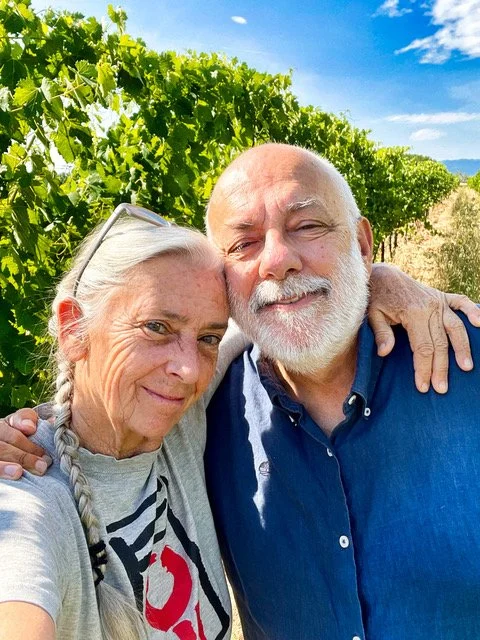
Carla Benini and her husband Edoardo Ventimiglio
Nocchianello Nero: Recovering a piece of Pitigliano’s viticultural history
Nocchianello Nero is an ancient grape variety originating in the Pitigliano area, whose genetic parentage remains unknown.
Its documented history goes back at least to 1883, when it was mentioned in the Inchiesta Agraria (Agricultural Inquiry) for the provinces of Rome and Grosseto.
Like many local grape varieties, Nocchianello Nero belongs to a viticultural heritage that was progressively reduced as Italian vineyards were reconstructed following the arrival of phylloxera. The replacement of vineyards and the increasing concentration on a smaller number of commercially favoured varieties contributed to the loss of much of the genetic diversity once present in Italy’s vineyards.
Some exceptions survived. Small, sometimes centuries-old, ungrafted vineyards escaped phylloxera, while other isolated plots preserved plant material passed down from one generation to the next through local tradition. Such surviving vineyards can hold valuable genetic material, but their continued existence is far from guaranteed.
When a vineyard disappears without its plant material being identified and conserved, the loss may be permanent.
Nocchianello Nero is an example of what can be recovered when someone recognises the importance of that heritage and commits to preserving it.
From the CREA collection to the vineyards of Sassotondo
The recovery of Nocchianello Nero involved the work of CREA in Arezzo, the Italian agricultural research organisation, and the dedication of Carla Benini.
Paolo Storchi, who headed the CREA work in Arezzo, recovered the variety from vineyards in the Pitigliano area. This followed a specific investigation originally initiated by Professor Giancarlo Scalabrelli of the University of Pisa and Professor Angelo Grasselli.
Sassotondo began cultivating Nocchianello Nero in 2010.
The variety has some distinctive agronomic characteristics. It adapts well to the poor, tufa-rich soils of Pitigliano, where it behaves differently from the same variety grown on the more fertile plains around Arezzo, where the CREA collection is located.
Its bunches are relatively small and moderately compact, its basal bud fertility is not particularly high, and its berries are firm and contain relatively large seeds. The name Nocchianello may derive from nocchia, meaning hazelnut, possibly a reference to the size of the seeds.
Despite its modest fertility, the variety produces a distinctive, high-quality wine.
These differences between growing environments are particularly interesting. They underline the importance of understanding a grape variety in the context of its original territory, rather than considering its genetic identity in isolation. Soil, climate and growing conditions all contribute to the way a vine develops and expresses itself.
Since 2017, following an application by CREA in Arezzo, Nocchianello Nero has been included in the Italian Ministry’s National Register of grape varieties and authorised for cultivation throughout Tuscany.
At Sassotondo, the variety is bottled under the name Monte Rosso.
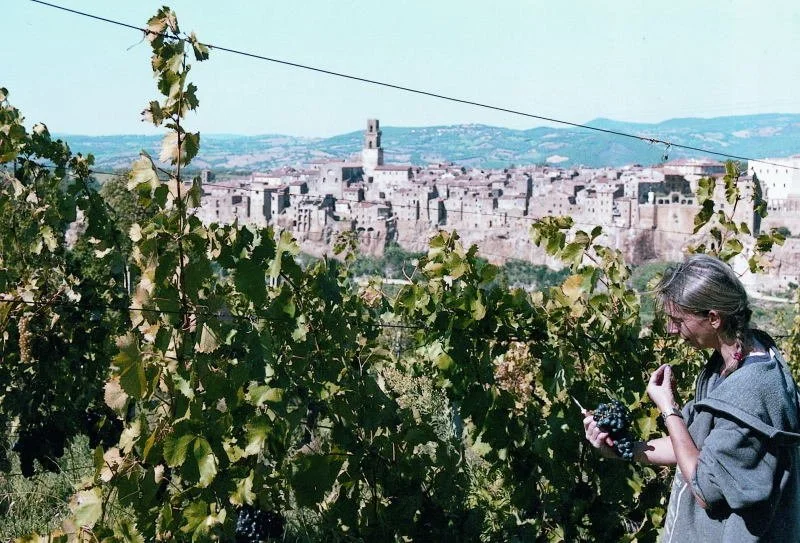
Carla Benini in her historic San Lorenzo vineyard planted with Ciliegiolo in the 1960s
Old vines, genetic diversity and the future of Italian wine
The story of Nocchianello Nero raises a question that extends well beyond Pitigliano: how much viticultural diversity have we already lost, and how much remains at risk?
Old vineyards are not valuable simply because of their age. They can also preserve genetic material, local adaptations and the accumulated knowledge of generations of growers. Where vines have survived in their original environment, they may provide opportunities to rediscover varieties and better understand their relationship with a particular territory.
It is important, however, to distinguish between the age of a vine and the identity of the grape variety it produces. An old vine is not necessarily a rare or endangered variety, just as a rare variety is not necessarily grown on old vines. The two are different aspects of viticultural heritage, although they can intersect in ways that make their preservation particularly valuable.
This distinction is relevant to the work of the Old Vine Conference, which advocates for the recognition and preservation of old vineyards and highlights their significance for wine, landscapes and the future resilience of viticulture.
The conservation of old vines and the recovery of endangered grape varieties share an underlying principle: both seek to protect resources that have accumulated over generations and that may be difficult, or impossible, to replace once lost.
Preserving this heritage requires more than documenting old vineyards. It also means identifying the varieties they contain, studying their characteristics, maintaining planting material and, wherever possible, giving these grapes a future through cultivation and winemaking.
This is where the work of people such as Carla Benini becomes particularly relevant to the international old-vine movement.
Nocchianello Nero demonstrates how the commitment of a grower, supported by scientific research, can bring a forgotten variety back into cultivation and preserve it for future generations. It also illustrates why the conservation of genetic diversity deserves a place in the wider conversation about the value of historic vineyards.
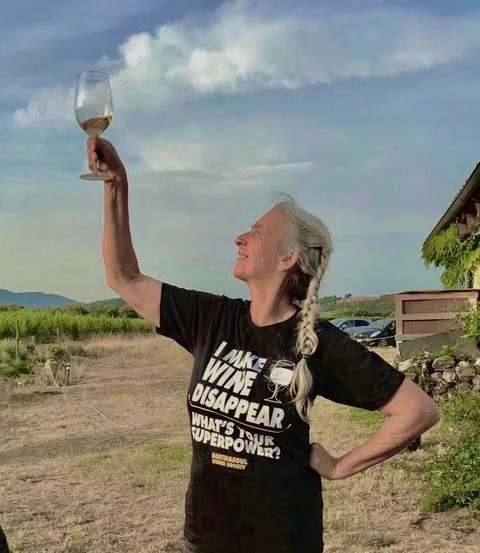
Carla Benini, Sassotondo
Preserving the past to shape the future
Carla Benini’s appointment to the Italian Academy of Vine and Wine recognises a professional journey that combines agricultural knowledge, environmental commitment and scientific curiosity with a determination to protect a part of Italy’s viticultural heritage.
Her work reminds us that the preservation of viticultural diversity is not an exercise in nostalgia. It is about maintaining a resource that may prove increasingly valuable as winegrowers respond to changing environmental conditions and reconsider the varieties best suited to their territories.
The story of Nocchianello Nero is therefore about more than the revival of an almost forgotten grape. It is about the people who recognise the value of what remains, the scientific work required to understand it, and the commitment needed to ensure it has a future.
For the Old Vine Conference, it is a timely reminder that the heritage of our vineyards encompasses not only the age of the vines themselves, but also the genetic diversity, local knowledge and cultural history they may preserve.
Grape varieties rooted in the past, with a place in the wines of the future.