
Episode 8
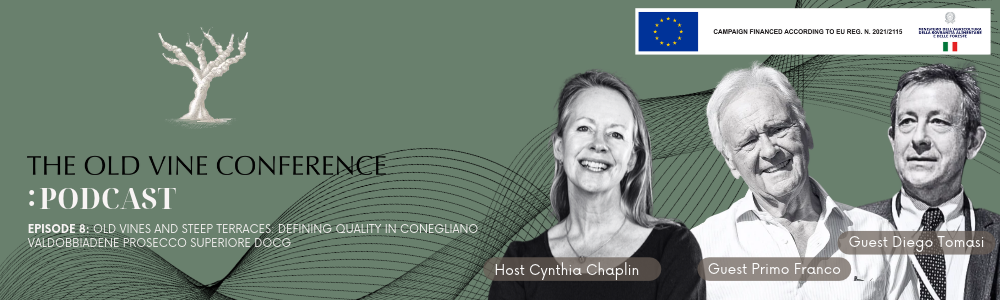
Transcript – Episode 8: Old Vines and Steep Terraces: Defining quality in Conegliano Valdobbiadene Prosecco Superiore DOCG
With guests Primo Franco & Diego Tomasi
The Old Vine Conference Podcast.
Cynthia Chaplin
Hello and welcome to the Old Vine Podcast. I'm Cynthia Chaplin, your host, and today I am delighted to welcome the Consorzio di Tutela Conegliano Valdobbiadene Prosecco DOCG. This is the body that protects and promotes the denomination for the Conegliano Valdobbiadene Prosecco DOCG wines. With me, I am so pleased to have Diego Tomasi, the director of the Consorzio, and Primo Franco from the historic Nino Franco winery. Thank you very much for both of your time today and taking a look at the very important role that old vines have to play within the denomination of Prosecco Superiore DOCG.
I want to give a small bit of background for our listeners. Prosecco is, of course, the sparkling wine made using the Martinotti or the tank method, produced in Veneto and Friuli Venezia Giulia in the northeast of Italy. The Conegliano Valdobbiadene Prosecco Superiore DOCG is a small area inside the wider Prosecco DOC, specifically in the Treviso hills north of Venice, where wine has been made in one form or another for over 2,000 years. The denomination covers approximately 8,000 hectares of vines, with over 3,200 families of growers and 270 wineries currently members of the Consorzio. It's very important to understand that of those 8,000 hectares, 2,000 of the denomination are grown on only 4760 kilometers of very narrow ciglione terraces. So unlike a conventional stone-walled terrace found in other wine regions, ciglioni are held together entirely by grass and a very dense root system rather than stone walls. So this is a very unique and very important area in the Italian winemaking world.
So I'm going to start by asking a few general questions. We know that we have some topics that we need to cover. One of the challenges facing both Prosecco DOC and Prosecco Superiore DOCG in the area of marketing and communication is this worldwide confusion between the name of Prosecco, which is a place, and the grape Glera, which is what the wine is made from. So how can we improve our ability to clarify and explain for consumers these details and these distinctions, which are really important?
Diego Tomasi
Okay, I can start. This problem is the main goal and the main effort that the consortium is doing year after year. And how to achieve the goal? First of all, to invite people to visit our area. I mean journalists, influencers, buyers, Masters of Wine, and to try to see and to touch our reality, the quality of our products, the steep hills, and so on. Then masterclasses are another very strategic tool to explain our differences.
I had approximately 100 masterclasses a year, just on different occasions, in Italy and abroad, just to explain the differences. But every other tool that showcases our area, our history, our landscape, and our heroic viticulture—meaning TV, meaning magazines—we try to use every day different tools to explain our differences. But we try also to increase our presence in HoReCa and the food service sector, restaurants for example, because it is so important to explain to our consumer directly, to explain directly the differences.
Because if you are in GDO, unfortunately it's the price that speaks for you. And the price usually wins compared with the DOCG, and comparing the DOCG and the DOC. So this is the reason why we try to be present in the high-level sector of our distribution, I mean HoReCa, restaurants. And we try to see the differences, to touch the differences, but also explain that we are not the entry-level Prosecco, we are the original one. Our wine came from a perfect match between environment and variety.
Cynthia Chaplin
Primo Franco, what are your thoughts about how we can work better on this topic of explaining the differences between Prosecco DOC and Prosecco Superiore DOCG?
Primo Franco
So I will say, it's typical of the big appellations, and Prosecco is quite a big appellation to cover a big region. We are talking about Prosecco, but if you think of Bordeaux, if you think of Burgundy, if you think of Franciacorta, there is not a village under the name Franciacorta. There is a wine under the name Franciacorta.
In the past, in 2009, we needed to protect in some way our job first, and then the business, from all the Prosecco that were copying us around the world. So we decided to cancel the name Prosecco from the list of European authorized grapes to switch to a big umbrella to cover the area and to call it Glera.
But I would say that Prosecco as an appellation is something that has to be in some way communicated through education, as Diego said. And also to know labels. I had a guest at the villa—I have a bed and breakfast—two English women last weekend, and they were looking at the Prosecco from Waitrose, and I said, "You will never find Waitrose Prosecco in Valdobbiadene, because this is a private label." So I would say the confusion is made sometimes by people that don't know how to read the label. It's almost impossible to explain to all the consumers, the Prosecco consumers, the difference between the DOC and the DOCG. But first of all, they should turn around the bottle and read the label. Once again, as I said, we needed to do that. We don't have choices, you know, but...
It is typical if you think of Chianti, Chianti Classico, Chianti Classico Superiore. If you think of Bordeaux, there are 55 sub-denominations in Bordeaux, you know? And the grape is called the name, blah, blah, blah. So we did something that in other countries was already existing: to have a name, an umbrella for the area, and then the grape under the umbrella.
Cynthia Chaplin
Yeah, I think this is really important, and as an educator myself, I spend a lot of time encouraging my students to read back labels and to understand we don't make life easy for consumers in Italy. Our labels are not that clear all the time. Valdobbiadene, Conegliano, Prosecco Superiore—these are big words that non-Italian speakers struggle with. But I think the more often that we can get these very important and very specific names in front of people, the more we will get them to look for them and to understand that they are a sign of quality. So I agree with both of you on that.
Speaking of masterclasses as a tool, I was very fortunate to attend a masterclass, as I said, presented earlier this year by Diego, and he famously said, "Not all Proseccos are created equal." The reaction of the international people in the room was very interesting. There was a lot of laughter, but I'm not sure there was a lot of understanding. So I think it's absolutely true that we press this message, and Diego, you're very good at doing this. I've seen you do it.
It's one of the most important messages the consortium needs to communicate. So we know the world has been happily swimming along in a great big ocean of Prosecco for the past several years without really understanding the various quality levels, which is what we're talking about here with Prosecco Superiore and the distinctions, as Primo Franco mentioned, in the category.
Primo Franco
A very important thing is that the appellation is a common asset. So it's an asset that belongs to the entire community, and it has to be respected. And then there is the name of the brand, the name of the winery, which is a proprietary asset. And this is the asset that guarantees a double guarantee about the quality. So as Diego said before, it's not only a question of price, it's a question of scouting to understand which kind of brand will guarantee you the better quality. When you buy Champagne, you don't buy Champagne, you buy Moët & Chandon, blah, blah. Champagne is in your mind, but then you have the label.
So this should be the same for Prosecco. So who buys the wine in your country? Tesco, Waitrose—they all have a private label. So for people, it's not easy to say, "Look at the back label."
Cynthia Chaplin
And I think, you know, we're also talking about a relatively small area. You know, the numbers tell a story. There are 8,000 hectares in Prosecco Superiore, but there are 217 wineries. We're talking about very, very small productions. You know, people don't have hundreds of thousands of acres. So the quality level is absolutely key, and understanding the label, the winery, and knowing where it's coming from, I think, is definitely key. So, again, as we're saying, how do we set this tiny area apart from other sparkling wines and particularly from other Prosecco DOC wines in Italy?
Diego Tomasi
We have to speak about the Glera variety. It is almost certain that the Glera variety was born in Prosecco town, close to Trieste, in the Friuli area. But in those areas, those varieties didn't find the right climatic and soil conditions to give the right quality, the right quantity. And so this variety started a longer period—probably it lasted 300 to 400 years—of what you call pilgrimage. Because we are sure that in the 1700s, it was in the Vicenza area.
And then this variety moved after 100 years to Colli Euganei, close to Padua. But also there, it didn't find climatic or soil conditions, or tradition, I don't know what. And so after another 100 years, at the beginning of the 19th century, it arrived in Conegliano Valdobbiadene, and here it found the right conditions. I mean the rainfall: 700 mm of water from April to September; the right temperature: nice temperatures in the springtime, just because it's a very early variety; and then also very long-lasting autumns, just to have a perfect ripeness for this variety. And so...
Here it found the best conditions to give the best quality. And what happened? That it remained only here for more than 200 years. And then, probably 30 to 35 years ago, just due to market demand, a commercial demand, it moved from the hills to the plains, to the flatter area below these hills. But it is very important to remember that the hillside was a free choice of the variety. It ran along from Vicenza, and then it arrived here and found the right conditions. The flat area is an imposition—an imposition that men, the growers, have done just to make money, just because it was very successful to produce Glera. So this is the main difference: a free choice in the hills by the variety, because the variety itself found the right conditions, but in the flat area it has been man that imposed, that obliged this variety to produce the basic level in terms of quality of this grape.
Remember also, to receive this variety, to welcome this variety, the older generations dug by hand with very simple tools almost 5,000 kilometers of ciglioni. So this is very important. This is tradition, this is history, this is also... everything means 5,000 kilometers of ciglioni. Of ciglioni means poor soils, it means very low production, very high quality, low vigor, and so on. So this is a thin area, perfect for our variety. And those varieties stopped here, and only because men followed the gain, the money, and so on, they moved this variety to the flatter area. But for sure, the hillside in Conegliano Valdobbiadene is where you can find the highest level in the chemical composition of the grape and then also in the glass.
Cynthia Chaplin
I think this is absolutely true.
So we're talking about areas that are very near and dear to me. As we roll from the west in Verona towards the east, towards where Conegliano and Valdobbiadene are, we do start to roll through these hills that become incredibly important to the grape. So let's talk about these unique locations of the vineyards within the denomination. It's really crucial, as you've said, and the land is so special that UNESCO awarded it Cultural Landscape status in 2019. So we don't have slides today, so can you both paint us a verbal picture of these hogback hills and these grassy terraces, and what...
Diego Tomasi
From my part, and then Franco could explain what it means for the vine growers to have ciglioni. So there are two different aspects for me. Hogback means a specific shape of the hills; it's a sort of pyramid that exists also in Colorado, exists also in Iran, but only here in Conegliano Valdobbiadene was man able to make productive such steep-sloped hills. In other conditions, the hills are covered by forest, or by pasture, or there are bare rocks, and so on.
Ciglioni means very narrow terraces, 80 cm, 90 cm, where you cannot use any mechanical equipment, where you are obliged to do everything by hand. But to produce the ciglioni with, I repeat, very simple tools, you respect the morphology, you respect the soil, the geology of the soil, and so now we are obtaining a grape in a sort of original condition. So this is another important element that makes our hills so unique and so productive. If you move our hills to another part... So I think that really means something specific. Then inside of our hillside, we also have the rivé. Rivé means a specific area where the soil and the microclimate are unique. And so we have divided our area into 43 rivé; it is a sort of cru. And we know through chemical analysis that the grape, moving from one rivé to another rivé, is different in terms of sugar, acidity, but mostly about aromatic composition. So there is another big stroke of luck that we have in our area.
I will repeat that UNESCO gave recognition to the work that the people have done for probably 200 years to prepare the soil for the variety, and just to respect—a gentle respect between man and nature.
Cynthia Chaplin
So we know that all of this sort of manual work and the difficulties—the slopes are steep, the terraces are narrow—this comes at a cost. This has to be very strategically managed. So, Primo Franco, can you talk to us a little bit about the vineyard management, the costs that these conditions sort of put onto the wineries to get this very high quality of grapes?
Primo Franco
Well, the cost of managing a vineyard on the ciglioni, or in the very steep hills that are not ciglioni but are still very steep, I would say maybe it's eight or ten times working one hectare down in the valley, down on the plain.
It's very, very hard; it's quite difficult. And also, working in the ciglioni, you have a problem when you have old vines that are going to die because of something. To replace the old vine with a new vine in the ciglioni, you need to take care of the young vine like a baby, you know. You have to bring the water when needed. For example, this year it was quite a problem to give water to the young vines that were planted on the steep hills, because of the special summer that we had—very hot and without water. And then you also have something which is very, I would say, special to the area: to work with the diversity that you have inside this vineyard. So you have young vines, old vines, you have clones, you have different rootstocks, sometimes you have vines without rootstocks.
Cynthia Chaplin
So the soil in this area is very particular. It's formed from morainic and sedimentary deposits, conglomerates, pebbles, sand, and other very poor soils that are very well-draining, which is great when we get a lot of water. As you mentioned, this summer we've had no water. It's been a drought summer here, very, very hot. But these soils are very friable. It's easy for the roots to penetrate down to great depths. So go ahead, Primo Franco, please tell us: how does this soil make the region so supremely suitable for the protection and the success of the old vines? Because your vineyard has some very, very old vines indeed.
Primo Franco
Yeah, but you know, I hope that now Diego will agree with what I'm saying now.
In the appellation, at a certain point, there is a creek—the creek's name is Soligo—and it divides the appellation into two: the Valdobbiadene part looking west, and the Conegliano part looking east. Because of the soil, because of the differences that we have in the soil, the Valdobbiadene hills have a more elegant... the soil means, you know, that it drains very well. So in the end, the result of the wine is you have elegant, sometimes skinny wines.
But, you know, making sparkling wine is the art of blending. So they will then match perfectly with the power of Conegliano, where soils are completely different. But I also want to say something about the soils. The vine by itself is a lazy plant. If you give water to the root, they will stay up, you know. If you don't give water, it's going down very deeply to find the water. So water is important when you have young vines, to take care of them until they are ready, until they can be independent. But...
One of the vineyards where we have the old vines is an unusual, very deep clay in Valdobbiadene. Clay is not typical of Valdobbiadene. We have this kind of soil that we were talking about, mixing sand, stones, clay, shale, all these kinds of things. So once again, we believe that these old vines had deep roots. Then, when we had to explant some of these vines because of Flavescenza Dorata, we discovered that the roots were almost flat because there was water running deeply, keeping always a certain kind of humidity in the soil. So as I said, you know...
Prosecco is something that has belonged to us forever, you know. Even if the number nowadays is a little bit bigger. But also the historic wineries that were working in Conegliano at the beginning, they were bringing the grapes from the Valdobbiadene area because of the elegance of the wine from Valdobbiadene. Then you need to know how to work with elegance, not to destroy the elegance that Mother Nature gives you.
Cynthia Chaplin
Yeah, this is key. This is where the skill of the winemaker, skillful use of technology, and a deep, really profound understanding of your vineyard, your soils, and your climate come into play. This is not easy work. This is the alchemy of a winemaker. So we're on the topic of old vines that are in the Conegliano Valdobbiadene Prosecco Superiore area, and I know that there is a mixture of historic biotypes that you've both referred to—this diversity in the vineyard, different clones of Glera—and some of the rivé sites have vines that are over a hundred years old. So Primo Franco, how many old-vine vineyards are there in the DOCG overall?
Primo Franco
Well, you know, they say that there are 1,500 hectares.
I have the book of the appellation—it's the old register of the appellation from 1965, and the appellation started in 1969. At that time, there were in this book 1,300 hectares of vineyard, and they supposedly were almost half ciglioni and half hills of Valdobbiadene, and they were shared between 990 families. So the economy of the area didn't rely on wine in every way, but there was this kind of respect for this wine. Then I would say that Valdobbiadene, historically speaking, I believe has the largest part of these old vineyards. In 2014, a friend of ours asked us to visit, to care for an old vineyard that belonged to her mother.
This place, I would say, is inside the comune of Valdobbiadene, but it's not in a noble place like the Rivé di San Floriano or something like that. It's a flat place. Then it's a kind of ciglioni that goes down. But when we arrived—it was me, my daughter Silvia, and the winemaker—we discovered it was like being in a retirement house for old vines, you know. Mamma Mia, you said, no? And with very, very big size vines.
And then we discovered that there was this kind of tradition to reproduce the vine through rincalzo or propagine, technically speaking. So they bring a branch, turn it around, and put it under the ground. Some of them were without rootstock, and some were grafted on top of Riparia Gloire de Montpellier. But...
So at this moment, we decided to do what I love very much, because I love diversity: we did a massal selection. So, with the help of a scientist, we have been following this vineyard, professionally speaking, for five years. We have all the different levels, and then we chose, we marked 220 vines.
And inside these 220, we then did a further selection of 79 mother vines. And all the 79 mother vines gave us the idea that they have inside a memory of the immune system that allowed them to go through time for many years, saving themselves from all the vine diseases, you know—especially the last two diseases that are very, very problematic for us, which are Flavescenza Dorata and Mal dell'Esca. And so we named these vines with numbers, and we started to reproduce these vines to keep the diversity, to have a small vine to put inside our vineyard where we are losing a vine. From this vineyard, we are getting this wine that is called Nodi, because of the knots of the old vines, you know. But it is also a heritage of these old vines. Of course, you have to know how to work with diversity, and then, you know, this is the knowledge and the brain of the winemaker and the owners.
This year, it was a very difficult year. The old vines were showing beautiful leaves, a beautiful crop. We didn't have the chance to give water, so they had to survive with the water that didn't come.
Diego Tomasi
It depends on the root apparatus—how deep the roots are, how diffuse the roots are. I think that old vines mean roots. This is the difference between young vines and old vines: roots. So for sure, the challenge is to have plants with more capability to go down, down, and down looking for water, because the first goal of the roots is looking for water, and only after looking for nitrogen, potassium, and so on. But first of all, the genetic behavior of the roots is to look for water. And I totally agree with Primo Franco that if you have different genotypes, different clones, and so on, it's not enough; you also need to have a good root system.
Primo Franco
The difference between Prosecco DOC and the DOCG—connecting now with what I said—the biggest difference between the DOCG and the DOC is the diversity of the vineyard in the DOCG. Where down in the valley they have the same kind of soil, the same kind of rootstock, and the same clone, they are—allow me to say—they are all tall, blue-eyed, and blonde.
Cynthia Chaplin
Ha ha ha.
Primo Franco
So, where up here, we used to say we have this vigneto di popolazione—a vineyard that represents the population because of the diversity that there is inside. This is the most important, in my opinion. Then, at the end of this, if you recognize the diversity and you know how to work with the diversity, you will succeed with the quality of your wine.
Cynthia Chaplin
Absolutely. I am one hundred percent in agreement with all of this. And I'd like to ask both of you: you are doing a lot of very technical, expensive, time-consuming, difficult work with rincalzo and propagine as well, with massal selection, finding the right new mother plants that resist drought and resist disease. Why are we doing all this work? What ends up in our glass that is so special?
Diego Tomasi
Yes, to maintain our traditions also in terms of genetic materials, but also to maintain the quality of our wines, trying to give an answer to climate change—because the old plants are able to suffer less against climate change. But also, you know, if you maintain the old plants, you can also have the maximum results in terms of the valorization of the rivé. If in one rivé maybe you... I don't know why exactly, but in one rivé you have certain types of genotypes, and if you conserve these genotypes, you conserve also the tradition, the quality tradition. You also conserve the differentiations among the different rivé. So to take care of the old vines, I think, means everything. But...
As Primo Franco underlined before, to have old vines means, probably, a big, big span of time. You cannot create your tradition like in the flat area in a few years or in a short time. So yes, in the flat area the vineyards are perfect in terms of scientific choices, clones, rootstocks, trellis systems, plant density, but everything is equal. Everything is equal.
And another fact is that you can also manage the water. We cannot have enough water, but in the flat area, you can manage the water. So you can also have... every year, you don't care about the rainfall. You have artificial irrigation, and so you can work, you can go ahead without any problem. So these are big differences. To manage our vineyard is very hard, and you can manage our vineyard only if you are patient and coherent, and that is the main difference.
Cynthia Chaplin
We understand the differences in the soils and the hillsides versus the flatlands, and the amount of work that maintaining the old vines takes. But how do we convince our buyers and our importers and our consumers? Why should they be looking for Valdobbiadene Prosecco Superiore? What makes it... what does it taste like? Why is it better than just the flatland Prosecco DOC? What does it taste like? It's a hard question.
Primo Franco
Unfortunately, the image of Prosecco nowadays is quite cheap. This was not the case 30 years ago, even if the Treviso province was already producing Prosecco—maybe not as a DOC, but as an Igt, so it was under different rules.
But the problem is when the big distribution... when they discount, they discover something that runs, that goes very well. They ask for price. They ask for average quality. And so they will always find a specialist in mass quantity. So I would say that even if the DOC in some way has the same rules as the DOCG—because they have the state seal on the bottle, so every single lot has to be submitted to this independent tasting panel that sometimes doesn't like my wine...
Once again, going back to diversity: it is something that you can't drive. We have to go back to, as I said at the beginning, people have to come to Valdobbiadene and go scouting. They don't have to just visit the vineyard or the tasting room; they have to visit the winery. They have to see the cellar. They have to see the tanks for the first fermentation, the tanks for the second fermentation. They have to see the bottling plant. So in the end, it's like being in a kitchen, you know? Everything to make food, because... sometimes you are convinced you have food prepared five minutes ago, a dish, but it is a vacuum-packed dish.
I believe that the producers are responsible. Every single producer is responsible for his quality. As I said before, the appellation is a common asset, and the brand is a proprietary asset. Sometimes the common asset is not respected because people say business is business. Everywhere, in every business, you can find people that are greedy. And when you are greedy, you run a little bit in a different way, you know?
And answering your question, this is what I think about it. We don't have choices. We have to speak for ourselves and help the Consorzio to communicate it, to do education in the best way. We have to be brave to tell the truth. So to tell people: turn around the bottles, look at the label, do like Champagne producers do - you know, that RM, NM, Récoltant, Négociant-Manipulant, all these kinds of things. So we don't have the exact same things, but if you see a code, you will understand if it's the producer or something like that.
Cynthia Chaplin
Well, I'm going to take a step backwards just because Diego brought up an issue that is challenging all of us in the wine industry and challenging Italy quite a lot recently: climate change. There is no way to avoid this. A long time ago, when I first met Attilio Scienza, he said, "Cynthia, we cannot fight climate change; we must adapt and find a way to make it an opportunity and not a problem."
So I know that the Conegliano School of Enology was founded in 1876, so 150 years ago. The region, as you said, received its DOC in 1969 and the DOCG in 2009. So I want to talk a little bit about how things have changed over these past 150 years. This summer has been diabolical for us in Italy. We had terrible hailstorms, we had weeks and weeks of temperatures at 38, 39, 40 degrees. The harvest was early, without any rain.
The Regional Agency for Environmental Prevention and Protection of Veneto announced in June and July that it was the hottest period since 1991, driven by this long heat wave and very high temperatures. So our harvest dates are creeping backwards from the beginning of September right up to the beginning of August. So let's talk about what climate change is doing in Conegliano Valdobbiadene, with particular focus on 2026. So number one: what's happening? And number two: how are you adapting? How are old vines helping to find opportunity in the face of this challenge?
Diego Tomasi
Yes, speaking about 2026, to be honest, we had already experienced such unusual climatic conditions in 2003, in 2015, in 2022, and also this year. But what is the new dramatic condition of 2026? What happened?
We had an overlapping, at the same time, of several climatic factors. For example, we had more than 65 days with maximum temperatures above 30°C. But in the meantime, during the night, we had a lot of nights with minimum temperatures above 23°C—I mean super-tropical nights. Instead of having 18–19 degrees, we had 23 degrees. And we had only 100 mm of rainfall over three months—June, July, and August—compared with the usual 300 mm of water. So as you told us, we had a harvest period 12 or 15 days earlier than usual. But fortunately...
Just from the first chemical analysis, we have a good level of sugar. We have just a slightly lower level of acidity. But also from the first tastings that we are doing now as a Consorzio based on aromatic composition, the first enological data is telling us that we have more compounds linked with tropical and exotic fruit and so on.
So, yes, it's been a dramatic year, but it's not exactly the first. We adapted and made a very short harvest period. Instead of taking 20 to 25 days, we completed the harvest in 15 days this year, just to bring the best balance between sugar and acidity.
We have to teach our winegrowers new strategies in canopy management, for example: trying to protect the grapes by using the leaves to shade them from the sun's rays and high temperatures. And also, we unfortunately do not have a huge quantity of subsoil water, but anyway we have tried to teach that subsoil irrigation is the best method to achieve high efficiency in water use. Then we are promoting the creation of small reservoirs, small basins, just to catch and collect the water in the springtime and then use it during the summertime. So there is movement. We are thinking about it, we are speaking about it, and we are looking for new rules, because for sure this is the climate that unfortunately we have to face in the future.
But we are also lucky because we are on the hillside, and the hillside is cooler. We have more air, we have better exposition, more altitude, and the steepness of the slopes varies, so we have a huge range of microclimates and can valorize the microclimates we have inside our denomination. So also from this point of view, the hillside is probably better positioned than the flat area to survive or cope with climate change.
Cynthia Chaplin
Yeah, absolutely. Absolutely. Are many of the wineries implementing subsoil irrigation?
Diego Tomasi
Yes, just because we are trying to conserve also the water that came from the roof, the winery roof. We try to collect and then to use this water, because sometimes it is enough to give water one time during the summer to save the quality and also the production. But also...
Primo Franco explained it very well: the roots are growing deeper and deeper. Also, the plant is trying to adapt to climate change. For sure, the first element is the depth of the roots. And so now we are trying to help the plant, but not in the same way that they are doing in the flat area. We are luckier, and for sure our environmental conditions give us the opportunity to save the differentiation between rivé and also to save the typicality of our wine. Probably this year we have a footprint that means more exotic fruit, more ripe fruit, and so on.
Cynthia Chaplin
Mm-hmm.
Diego Tomasi
It happened the same in 2003 that we had this kind of advance. But I believe that in the future, the future is not so dramatic, it's not so bad.
Cynthia Chaplin
Well, we'll use you as the example of the Consorzio, and now I'll take Primo Franco as the proprietary, specific winery owner, and I'll ask you sort of a similar question, Primo Franco. You know, you were the one who pioneered the first single-vintage Prosecco in 1983, and you moved your family's production exclusively to Valdobbiadene Prosecco Superiore. And you are obviously renowned for and very devoted to high-quality, site-specific Glera grapes, and you've been instrumental in promoting the reputation of premium Prosecco DOCG. So give us a little insight into what's happening at Nino Franco. What are you and your daughter Silvia doing in your vineyards with your old vines to adapt to these challenges with climate change?
Primo Franco
I was the only male of this big family that belonged to my grandfather and then my father. I was 13 years old, and don't ask me why, but I was quite convinced that I wanted to be an architect. And my father said, "No, you can't."
They sent me to Conegliano. They put me in the college, the school, and I came back six years later as an enologist. And then after a couple of years, university and so on, the war between the two generations started.
But it was a kind of positive war, because of course my father was my father and I was the kid, and I wanted to do things, but he gave me the chance to travel, never complaining about the expenses. And he was maybe too young to remember that in the beginning—in the 70s and the beginning of the 80s—there was this kind of revolution inside wine and food. And we did something different between wine and food. We had been growing together, the big restaurants, the big chefs, together with my generation of winemakers. But then something happened very suddenly: my father passed away in September 1982. It was a boom like that, you know. He was very young, because he was 61, and I was very young also, because I was 35. And because I was traveling quite a lot, I didn't... at the end of the day, I wasn't going to the osteria drinking a glass of wine together with colleagues like my father. And so people from the city, from the village, they were like, "Primo is going to shut down everything." So in some way, I needed to send a message to these old... you know, all these...
Cynthia Chaplin
Old-school guys.
Primo Franco
...kings of Prosecco, blah, blah, blah.
So, to make it short, with the '83 harvest, after drinking with some friends a bottle from my grandfather stamped February '56—and it was a demi-sec. So we have to remember that in the past, Prosecco used to be the wine for the end. It was the wine for the panettone, the wine for celebrations. Then we changed the style, and we also exported the lifestyle. So I said, "Why don't we go back to the old residual sugar?" And so I decided...
After drinking this bottle, to produce a small quantity of a dry Prosecco. At that time, we were not allowed to put "Dry" on the label yet. And so I chose a part of a vineyard from one of the few slightly larger ones, which is not in one of the most noble places - it's almost next to the famous Soligo creek—but with beautiful vines. So I decided to make this Prosecco, leaving a high residual sugar, so let's say 30 grams per liter of residual sugar, which is a Dry. It's almost at the end of Dry today.
So, putting on the label the vintage and signing the label with my name. So, I used the label from my grandfather with my name to say, "Hello, I'm here."
I succeeded. It was a little bit of good luck, you know, a little bit of knowing what I wanted to do. But the start of Nino Franco under Primo Franco's direction started in this way. In the meantime, I was traveling quite a lot in the United States, where, as I said, we exported the lifestyle. I said, "Listen, guys, if you are in Venice at 10 o'clock in the morning and you ask for a glass of Prosecco, nobody will look at you like an alcoholic. They will give you a glass of Prosecco with maybe some small thing to eat, you know, a kind of tapas." And once again, we succeeded.
Cynthia Chaplin
Thank you, Primo Franco, because I am that person who goes to Venice and says I would like Prosecco at eleven in the morning, and nobody gets upset about that. So thank you very much.
Primo Franco
But you know, there's also another story that comes from a very famous American writer. He's talking about spies, and one of these spies has to look and act like an Italian. But not only Italian—he has to be Venetian. And he said, "If we are in Treviso, of course, you need to speak Italian. But after 10:30, never ask for a cappuccino. You have to..."
Cynthia Chaplin
Ha ha ha.
Primo Franco
"...ask for a glass of Prosecco, and they will not discover you as a spy." So...
Today, we are with Silvia. Of course, we decided to do all this quite big job called Villa dei Poloni, which is the vineyard where the old vines are. It was quite an investment, because we have been following these old ladies for more than five years, and we are still doing that. But the main goal of this is that we hope people look to these vines because they are resilient.
And not only are they resilient, but we keep the diversity of Prosecco. Today many people are talking about PIWI. PIWI is a big opportunity, you know, it's an experience, but you will turn upside down the quality and the characteristics of some of these areas, you know. You can say it's a PIWI, so a PIWI can be in Vicenza, in Piemonte, in Valdobbiadene, in Santorini, wherever. Once again, we need—together with Diego, who is a scientist, you know, with the Consorzio—to find the way to reproduce these resilient old biotypes.
Diego Tomasi
Primo Franco, I have a very difficult question for you. Now we are doing this wonderful work, trying to preserve the old vines, the old genotypes, and so on. But in your intention, is it also to share part of this work with your colleagues? I mean, will you give all these old vines that you are preserving to your colleagues just to reproduce them, to have the genotypes and the massal selection that you are doing now spread out more, or will you keep the material that you are selecting now only for your winery, for your farm? Because I'm sure it costs money—it's not only time-consuming, but it's also money-consuming to do such a big project followed by scientists and so on. But anyway, do you have this philanthropic idea to give those materials to other colleagues, or not?
Primo Franco
Well, Diego, maybe you don't remember, but L’Antica Quercia—you know, the place that belongs to the Francavilla family—they gave us two hectares. And in these two hectares, we planted 6,000 small, new vines from this selection. And the wood from these vines is available for people who want this wood. We are reproducing every year a certain quantity of vines, and the extra quantity that we don't use in our small vineyard, we are giving away to the people who are paying the nursery for that. And so, of course, they have to trust in what we are doing, because you can think of these old vines, these old biotypes, like a human being. They have gone through years without having any problems, and then maybe something happens. But, you know, as I said, if we want to win in a market that says, "We don't want Prosecco," we absolutely need to keep our diversity.
It may be a little bit harder, it can be a little bit more expensive, but I believe this is the way. But anyway, we are open. We hope that all these—mainly the younger producers—ask for this wood, and we are giving the wood for free. For free. And also, you know, all the mother vines have a stainless steel tag on top to recognize them.
Behind this tag, there is the history of the mother vine. And every single daughter vine has a tag with a different color. So when we are going through our vineyard and we see the blue tag or the yellow tag, we say, "This is the daughter of this one." Sometimes it looks like mental masturbation...
Cynthia Chaplin
That was a note of color that we needed in this conversation! Thank you, Primo Franco.
Primo Franco
You're welcome.
Cynthia Chaplin
Before we go any further down that road, I'm going to ask Diego about another big project that's going on. The region of Conegliano Valdobbiadene Prosecco Superiore has over 50 percent of its vineyards certified SQNPI, which is the current sustainability benchmark in Italy. So how is the Consorzio—how are the wineries involved in this project—using the pillars of SQNPI to benefit the region, and what other research programs are underway?
Diego Tomasi
To update the numbers, to be precise, today we have reached 57% SQNPI certification. So it means that we need another 3%—which is equal, more or less, to 400 hectares—to reach 60% and be able to receive the third shield. The whole denomination is SQNPI certified. And nowadays, there is only one other denomination—Brunello di Montalcino—that has reached 60%. We will be the second one. So I think that in a few months, we can reach this important goal.
But what does it mean to be SQNPI certified? For example, it means taking care of the soil; for example, we don't use... we use only a minimum quantity of herbicide, meaning glyphosate. And then we take care of the air; we don't use insecticides, for example, to take care of biodiversity. 75% of our territory is covered by forest, 30% by vineyards, 9% by other cultivation, and 4% by urban sites.
But we have also a new project. For example, we started four years ago to try to avoid the use of chemical nitrogen as fertilization in the vineyard, just to demonstrate to our winegrowers that they can avoid the use of chemical nitrogen and try to use manure or other types of organic matter, like compost and so on.
Why? Because you know that chemical nitrogen has a big impact on climate change, so it's important. Probably in the future—in 15 or 20 years—it will not be allowed to use chemical nitrogen in agriculture, and so we are trying to explain now that it's possible to avoid the use of nitrogen. Because using organic matter means increasing the microbiology in the soil and also biodiversity. Increasing organic matter in the soil means that we can retain water better, because organic matter acts like a sponge that holds water. And so, this is probably the most important project that we are following now. We hope in two or three years to have the first answers, the first data, to confirm that this is another valid strategy for our denomination. In the meantime, we can also continue to increase the SQNPI certification and the percentage of our vineyards.
Cynthia Chaplin
I think the movement towards sustainability is really important, not only for the vineyards and the vines, but also for the story that we tell in our communications. New consumers are very concerned about sustainability, and I think the movement towards SQNPI and, as you said, less nitrogen is going to be a very, very important part of our communication moving forward. So I'm thrilled to hear that's happening.
You know, we're at the end. I've stolen an hour out of your day; I'm so grateful to both of you. Let me ask just one final question of you both. Since 2019, planting new vineyards in Conegliano Valdobbiadene has been completely forbidden. So the interaction between human beings and nature has created this stunningly beautiful area with over 4,700 kilometres of grassy terraces requiring all the work to be done by hand—the ciglioni that we've been speaking about. So where are we going in the future for the Consorzio di Tutela Conegliano Valdobbiadene Prosecco Superiore DOCG? What are the goals for the Consorzio, for your members, and for the reputation of your wines in the global market?
Diego Tomasi
I have to repeat all the ideas that we heard from Primo Franco. The future for Conegliano Valdobbiadene is based on two words: authenticity and coherence. So we need to preserve our history and our traditions. We don't need to chase or run after numbers, numbers, and numbers—also because we cannot increase the surface area. As you explained, we cannot plant new vineyards. And so...
We don't have to sell more and more bottles; we have to sell the bottles in the best possible way. I mean at the right price, to the right people, in the right places, maybe in the right countries that can give us more satisfaction for our quality, and so on. So the future is trying to think not about volume, but about quality. For me, this is for sure the future. And then to conserve our territory, to conserve our landscape.
And also now, there is a new strategy to try to combine wine tourism and wine. This could be another challenge for the future, but also in this case, we don't need huge numbers in wine tourism. We have to select wine tourism, because we are a very small denomination and we cannot accept too many people; our roads are not built for too many cars, and so on. So this is the future: coherence and authenticity.
Cynthia Chaplin
I think that's a brilliant two-step look at the future. It is a wonderful territory—as I said, it's not very far from where I live, a beautiful area. And the wines are really worth the time and effort to promote them and to explain how valuable their unique qualities are. So I'm very grateful to both of you, Primo Franco and Diego. Thank you so much for your time today. Thank you from the Old Vine Conference for becoming a regional member; the participation of the Consorzio is very valuable to the Old Vine Conference, and we appreciate all that you have done as supporters and members. So we're looking forward to seeing you at the national conference. Ciao!
Diego Tomasi
Yes, for sure. I will be there with Primo Franco. Okay, Cynthia, thank you. Arrivederci. Thank you, Primo Franco. Bye. Bye.
Primo Franco
Thank you.
Cynthia Chaplin
Thank you. Thank you. Bye, Diego. Ciao!