
Old Vines, Native Roots: Why the Future of Wine May Lie in Its Past
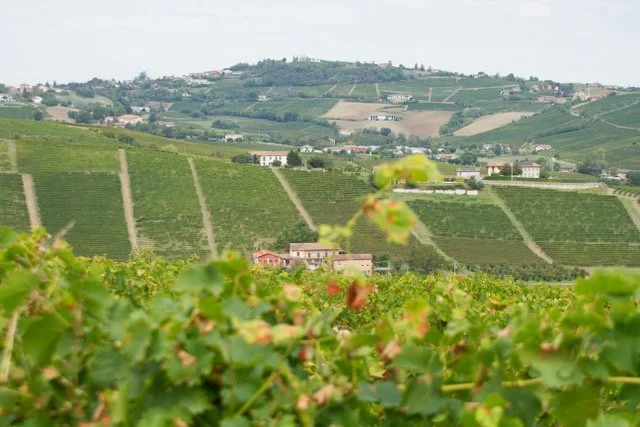
In Piemonte, Italy, member winery Tenuta il Finale explains how a renewed focus on old vines and indigenous varieties is offering a compelling response to the pressures of climate change—one rooted not in innovation, but in adaptation.
There is a quiet recalibration happening across the wine world.
As climate change accelerates, we, like many farmers, are being forced to reconsider long-held assumptions about ripening, balance, and even varietal suitability. Warmer growing seasons, compressed harvest windows, and increasing water stress are no longer abstract projections—they are realities shaping our vineyards today.
Here in Piemonte, we are seeing these shifts with particular clarity. Earlier budburst, faster sugar accumulation, and declining acidity are subtly but decisively altering the structure and style of wines. Piemonte, with its diversity of exposures, elevations and soils, is increasingly becoming a natural laboratory for understanding how traditional viticulture responds under modern climatic pressure.
The question is no longer whether to adapt—but how.
Rediscovering resilience in native grape varieties
For us, one of the most compelling answers lies not in newly engineered solutions, but in the rediscovery of autochthonous (native) grape varieties.
These grapes have evolved over centuries within this specific landscape. They are not simply grown here— they belong here.
At Tenuta Il Finale, we have chosen to focus on varieties such as Barbera, Arneis and Dolcetto—grapes that are deeply rooted in Piemonte’s history and identity. In a region where many may choose to plant more internationally recognised or commercially driven varieties, we see long-term value in working with grapes that are intrinsically adapted to this place.
Research increasingly supports what we observe in the vineyard: locally adapted varieties demonstrate greater resilience to environmental stress, including drought and heat. Their physiology—ranging from water-use efficiency to canopy behaviour—is aligned with the conditions in which they developed. In this sense, native varieties can be understood not just as heritage, but as a form of embedded climate intelligence, shaped slowly over generations.
In contrast, the global spread of a narrow selection of varieties has reduced vineyard biodiversity, increasing vulnerability to both climatic extremes and disease pressure.
For us, preserving and working with indigenous varieties is not only about tradition—it is a strategic decision for the future.
The role of old vines in a changing climate
Alongside varietal choice, vine age is another critical factor we see in our vineyards.
Old vines—typically defined as those over 30 to 50 years—offer a distinct physiological advantage.
Their deep, established root systems allow access to water reserves far below the surface, providing natural buffering against drought conditions. At the same time, their naturally lower yields contribute to more consistent ripening and balanced fruit composition, even in warmer vintages.
There is also growing interest in the genetic diversity present within older vineyards. Over time, mass selection and natural variation can lead to a broader genetic base within a single plot, potentially enhancing adaptability. These older vineyards effectively act as living repositories of genetic material, preserving variations that may prove critical as conditions continue to shift.
This is something we continue to learn through conversations and shared research within communities such as The Old Vine Conference—a collective we are proud to be part of and one that continues to shape and challenge our thinking as growers.
While old vines are often celebrated for the concentration and complexity they bring to wine, for us their role in climate resilience is just as significant.
Piemonte: tradition as a forward strategy
In Piemonte, these ideas are not new—but they are becoming more urgent.
At Tenuta Il Finale, our approach is grounded in observation rather than intervention. Working with native grape varieties and older vineyards that have endured decades of seasonal variation, we are learning to respond to the land rather than control it.
We are not trying to outpace climate change, but to work within its realities—drawing on the inherent strengths of the vineyard itself. In doing so, Piemonte offers not just continuity, but a blueprint for adaptive viticulture grounded in place rather than prescription.
We believe resilience does not come from uniformity, but from diversity. Not from control, but from balance.
Sustainability beyond certification
Sustainability is often framed through certification and process. While these frameworks play an important role, they do not fully capture the deeper decisions we make in the vineyard.
Choosing to preserve old vines
Choosing to cultivate native varieties like Barbera, Arneis and Dolcetto. Choosing to maintain biodiversity within our vineyard ecosystem.
These are not short-term adjustments, but generational commitments.
For us, sustainability is not something we apply—it is something we practice, season after season.
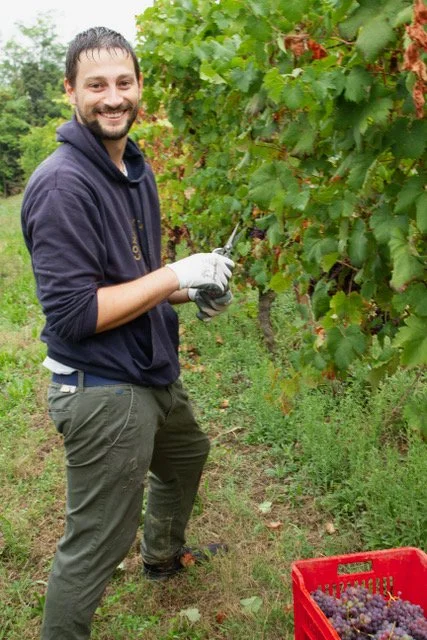
Hand-harvesting local grape varieties at Tenuta Il Finale
A return to equilibrium
As the industry looks ahead, the path forward may not lie in radical transformation, but in thoughtful recalibration.
Old vines and native grapes offer a model of inherent adaptation—one that has been refined over time, rather than engineered in response to crisis.
In this sense, the future of wine may already exist within its past.
For us at Tenuta Il Finale, the challenge and the responsibility, is to recognise it, protect it, and continue to grow with it.